Kapitel 4: Matrizen

4.1 Definition und Notation

Definition: Matrix

Eine Matrix Am×nA \in \mathbb{R}^{m \times n} ist eine rechteckige Anordnung von mnm \cdot n reellen Zahlen in mm Zeilen und nn Spalten: A=(a11a12a1na21a22a2nam1am2amn)A = \begin{pmatrix} a_{11} & a_{12} & \cdots & a_{1n} \\ a_{21} & a_{22} & \cdots & a_{2n} \\ \vdots & \vdots & \ddots & \vdots \\ a_{m1} & a_{m2} & \cdots & a_{mn} \end{pmatrix} Das Element in Zeile ii und Spalte jj wird mit aija_{ij} bezeichnet. Man schreibt auch A=(aij)A = (a_{ij}).

Beispiel

A=(120341)2×3A = \begin{pmatrix} 1 & -2 & 0 \\ 3 & 4 & -1 \end{pmatrix} \in \mathbb{R}^{2 \times 3} Die Matrix hat 2 Zeilen und 3 Spalten. Das Element a12=2a_{12} = -2 steht in Zeile 1, Spalte 2.

Übung

Gegeben sei B=(503127461)B = \begin{pmatrix} 5 & 0 & -3 \\ 1 & 2 & 7 \\ -4 & 6 & 1 \end{pmatrix}. Bestimme b23b_{23}, b31b_{31} und die Dimension von BB.


4.2 Typen von Matrizen

Definition: Nullmatrix

Die Nullmatrix 0m×n0 \in \mathbb{R}^{m \times n} hat ausschließlich Nullen als Einträge: 0=(0000)0 = \begin{pmatrix} 0 & \cdots & 0 \\ \vdots & \ddots & \vdots \\ 0 & \cdots & 0 \end{pmatrix} Sie ist das neutrale Element der Matrixaddition.

Definition: Einheitsmatrix

Die Einheitsmatrix Inn×nI_n \in \mathbb{R}^{n \times n} hat Einsen auf der Hauptdiagonalen und Nullen sonst: In=(100010001),(In)ij={1i=j0ijI_n = \begin{pmatrix} 1 & 0 & \cdots & 0 \\ 0 & 1 & \cdots & 0 \\ \vdots & \vdots & \ddots & \vdots \\ 0 & 0 & \cdots & 1 \end{pmatrix}, \quad (I_n)_{ij} = \begin{cases} 1 & i = j \\ 0 & i \neq j \end{cases}

Definition: Diagonalmatrix

Eine quadratische Matrix Dn×nD \in \mathbb{R}^{n \times n} heißt Diagonalmatrix, wenn dij=0d_{ij} = 0 für alle iji \neq j: D=(d11000d22000dnn)D = \begin{pmatrix} d_{11} & 0 & \cdots & 0 \\ 0 & d_{22} & \cdots & 0 \\ \vdots & \vdots & \ddots & \vdots \\ 0 & 0 & \cdots & d_{nn} \end{pmatrix}

Beispiel

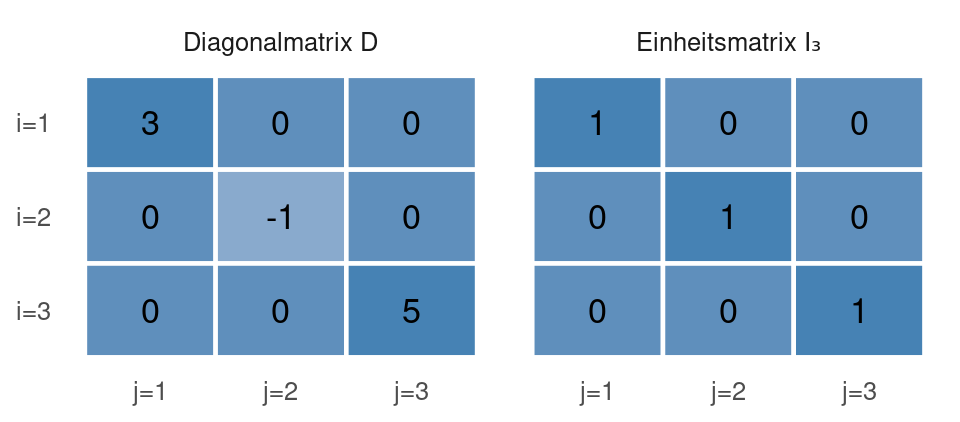
I3=(100010001),D=(300010005)I_3 = \begin{pmatrix} 1 & 0 & 0 \\ 0 & 1 & 0 \\ 0 & 0 & 1 \end{pmatrix}, \qquad D = \begin{pmatrix} 3 & 0 & 0 \\ 0 & -1 & 0 \\ 0 & 0 & 5 \end{pmatrix}

Übung

Ist jede Einheitsmatrix eine Diagonalmatrix? Ist jede Diagonalmatrix eine Einheitsmatrix? Begründe jeweils kurz.


4.3 Darstellung von Daten und linearen Abbildungen

Matrizen dienen in der Praxis zwei zentralen Zwecken:

Datendarstellung: Jede Zeile repräsentiert eine Beobachtung, jede Spalte ein Merkmal. Eine Datentabelle mit mm Beobachtungen und nn Merkmalen ist natürlich als m×nm \times n-Matrix darstellbar.

Lineare Abbildungen: Jede lineare Abbildung f:nmf: \mathbb{R}^n \to \mathbb{R}^m lässt sich eindeutig durch eine Matrix Am×nA \in \mathbb{R}^{m \times n} darstellen, sodass f(𝐱)=A𝐱f(\mathbf{x}) = A\mathbf{x}.

Beispiel

Die Abbildung f:22f: \mathbb{R}^2 \to \mathbb{R}^2, die jeden Vektor um 90° dreht, wird durch die Matrix R=(0110)R = \begin{pmatrix} 0 & -1 \\ 1 & 0 \end{pmatrix} dargestellt. Für 𝐯=(10)\mathbf{v} = \begin{pmatrix} 1 \\ 0 \end{pmatrix} ergibt sich R𝐯=(01)R\mathbf{v} = \begin{pmatrix} 0 \\ 1 \end{pmatrix}.

Übung

Was bewirkt die Matrix S=(1001)S = \begin{pmatrix} -1 & 0 \\ 0 & 1 \end{pmatrix} geometrisch? Wende SS auf 𝐯=(32)\mathbf{v} = \begin{pmatrix} 3 \\ 2 \end{pmatrix} an und interpretiere das Ergebnis.