Kapitel 2: Vektoren

2.1 Definition von Vektoren

Ein Vektor ist ein mathematisches Objekt, das sowohl eine Richtung als auch einen Betrag (Länge) besitzt. Formal ist ein Vektor ein Element eines Vektorraums.

Definition: Vektor

Ein Vektor 𝐯n\mathbf{v} \in \mathbb{R}^n ist ein geordnetes nn-Tupel reeller Zahlen: 𝐯=(v1,v2,,vn)\mathbf{v} = (v_1, v_2, \ldots, v_n) Die Zahlen viv_i heißen Komponenten des Vektors.

Beispiel

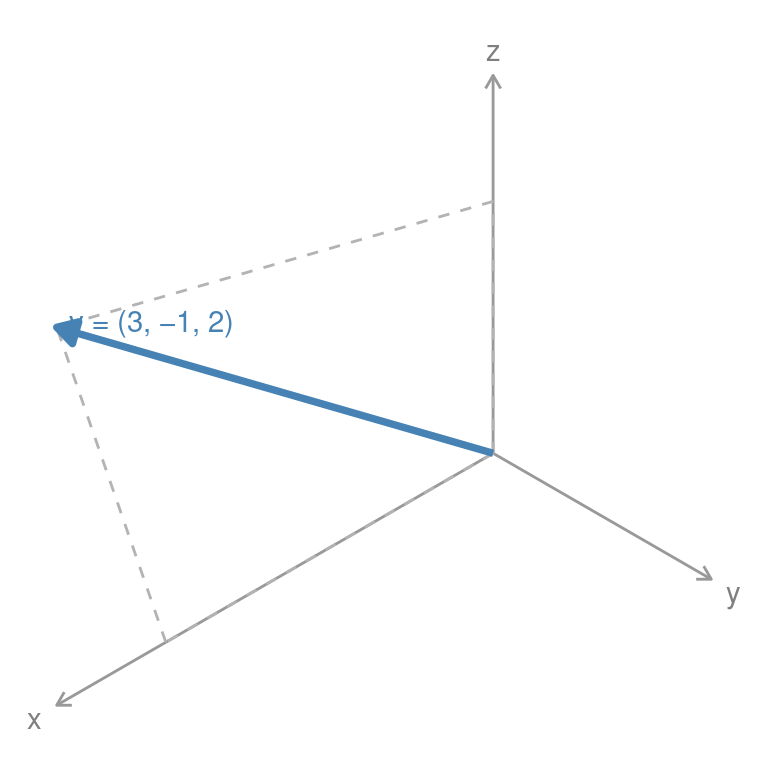
Der Vektor 𝐯=(3,1,2)\mathbf{v} = (3, -1, 2) ist ein Element des 3\mathbb{R}^3 mit den Komponenten v1=3v_1 = 3, v2=1v_2 = -1 und v3=2v_3 = 2.

Übung

Gegeben sei 𝐰=(4,0,3,7)\mathbf{w} = (4, 0, -3, 7). In welchem Raum liegt 𝐰\mathbf{w}, und was ist die dritte Komponente?


2.2 Darstellung im n\mathbb{R}^n

Vektoren im n\mathbb{R}^n werden als Spaltenvektor geschrieben: 𝐯=(v1v2vn)\mathbf{v} = \begin{pmatrix} v_1 \\ v_2 \\ \vdots \\ v_n \end{pmatrix}

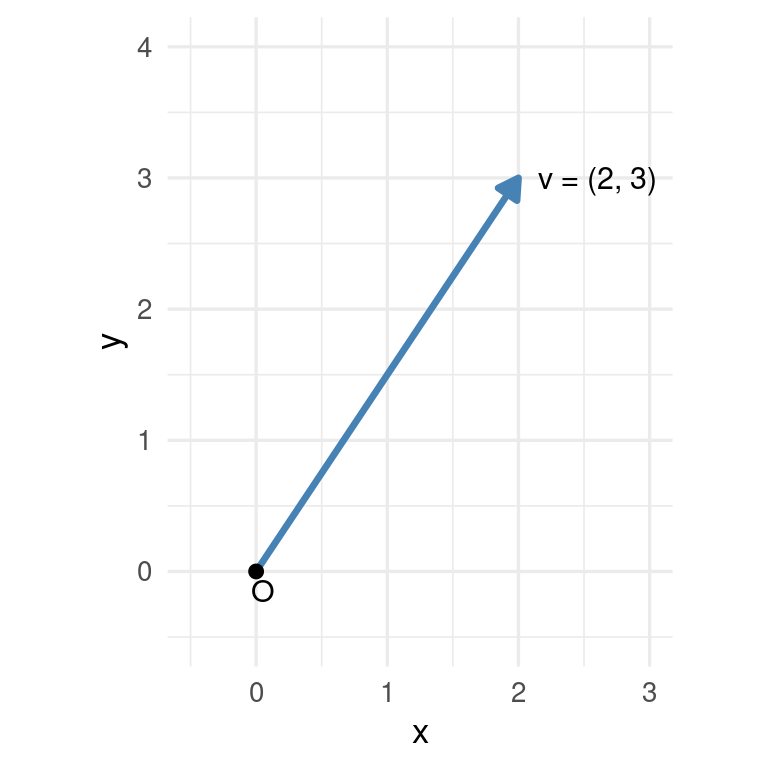
Im 2\mathbb{R}^2 und 3\mathbb{R}^3 lassen sich Vektoren geometrisch als Pfeile vom Ursprung zu einem Punkt darstellen.

Definition: Euklidische Norm

Die Länge (oder euklidische Norm) eines Vektors 𝐯n\mathbf{v} \in \mathbb{R}^n ist: 𝐯=v12+v22++vn2=i=1nvi2\|\mathbf{v}\| = \sqrt{v_1^2 + v_2^2 + \cdots + v_n^2} = \sqrt{\sum_{i=1}^n v_i^2}

Beispiel

Der Vektor 𝐯=(23)\mathbf{v} = \begin{pmatrix} 2 \\ 3 \end{pmatrix} zeigt im 2\mathbb{R}^2 vom Ursprung (0,0)(0,0) zum Punkt (2,3)(2, 3). Seine Länge beträgt 𝐯=22+32=13\|\mathbf{v}\| = \sqrt{2^2 + 3^2} = \sqrt{13}.

Übung

Bestimme die Länge des Vektors 𝐮=(122)\mathbf{u} = \begin{pmatrix} 1 \\ -2 \\ 2 \end{pmatrix}.


2.3 Vektoraddition und Skalarmultiplikation

Definition: Vektoraddition

Seien 𝐮,𝐯n\mathbf{u}, \mathbf{v} \in \mathbb{R}^n. Die Summe ist: 𝐮+𝐯=(u1+v1u2+v2un+vn)\mathbf{u} + \mathbf{v} = \begin{pmatrix} u_1 + v_1 \\ u_2 + v_2 \\ \vdots \\ u_n + v_n \end{pmatrix}

Definition: Skalarmultiplikation

Sei cc \in \mathbb{R} und 𝐯n\mathbf{v} \in \mathbb{R}^n. Das skalare Vielfache ist: c𝐯=(cv1cv2cvn)c \cdot \mathbf{v} = \begin{pmatrix} c \cdot v_1 \\ c \cdot v_2 \\ \vdots \\ c \cdot v_n \end{pmatrix}

Beispiel

Seien 𝐮=(14)\mathbf{u} = \begin{pmatrix} 1 \\ 4 \end{pmatrix} und 𝐯=(23)\mathbf{v} = \begin{pmatrix} -2 \\ 3 \end{pmatrix}. Dann gilt: 𝐮+𝐯=(17),3𝐮=(312)\mathbf{u} + \mathbf{v} = \begin{pmatrix} -1 \\ 7 \end{pmatrix}, \qquad 3\mathbf{u} = \begin{pmatrix} 3 \\ 12 \end{pmatrix}

Übung

Seien 𝐚=(210)\mathbf{a} = \begin{pmatrix} 2 \\ -1 \\ 0 \end{pmatrix} und 𝐛=(132)\mathbf{b} = \begin{pmatrix} 1 \\ 3 \\ -2 \end{pmatrix}. Berechne 𝐚+𝐛\mathbf{a} + \mathbf{b} und 2𝐛-2\mathbf{b}.


2.4 Linearkombinationen

Definition: Linearkombination

Seien 𝐯1,,𝐯kn\mathbf{v}_1, \ldots, \mathbf{v}_k \in \mathbb{R}^n und c1,,ckc_1, \ldots, c_k \in \mathbb{R}. Dann heißt 𝐰=c1𝐯1+c2𝐯2++ck𝐯k\mathbf{w} = c_1 \mathbf{v}_1 + c_2 \mathbf{v}_2 + \cdots + c_k \mathbf{v}_k eine Linearkombination der Vektoren 𝐯1,,𝐯k\mathbf{v}_1, \ldots, \mathbf{v}_k.

Beispiel

Seien 𝐯1=(10)\mathbf{v}_1 = \begin{pmatrix} 1 \\ 0 \end{pmatrix} und 𝐯2=(01)\mathbf{v}_2 = \begin{pmatrix} 0 \\ 1 \end{pmatrix}. Der Vektor (53)\begin{pmatrix} 5 \\ -3 \end{pmatrix} lässt sich schreiben als: 5𝐯1+(3)𝐯2=(53)5\mathbf{v}_1 + (-3)\mathbf{v}_2 = \begin{pmatrix} 5 \\ -3 \end{pmatrix} Jeder Vektor im 2\mathbb{R}^2 ist also eine Linearkombination der Standardbasisvektoren.

Übung

Seien 𝐯1=(12)\mathbf{v}_1 = \begin{pmatrix} 1 \\ 2 \end{pmatrix} und 𝐯2=(31)\mathbf{v}_2 = \begin{pmatrix} 3 \\ 1 \end{pmatrix}. Finde Koeffizienten c1,c2c_1, c_2 \in \mathbb{R}, sodass c1𝐯1+c2𝐯2=(55)c_1 \mathbf{v}_1 + c_2 \mathbf{v}_2 = \begin{pmatrix} 5 \\ 5 \end{pmatrix}.