Transformationen der Sinusfunktion

Klasse 10

Published

March 15, 2026

Grundidee

Die allgemeine Form der transformierten Sinusfunktion ist:

f(x)=asin(b(x+c))+df(x) = a \cdot \sin(b(x + c)) + d

Parameter Bedeutung Berechnung
|a|\lvert a \rvert Amplitude (halbe Schwingungsbreite) a=MaxMin2a = \frac{\text{Max} - \text{Min}}{2}
bb bestimmt die Periode T=2π|b|T = \frac{2\pi}{\lvert b \rvert}
cc Phasenverschiebung (nach links für c>0c > 0) aus Anfangsbedingung
dd Mittellage (vertikale Verschiebung) d=Max+Min2d = \frac{\text{Max} + \text{Min}}{2}

Vorzeichen: a<0a < 0 bedeutet Spiegelung an der Mittellage y=dy = d.

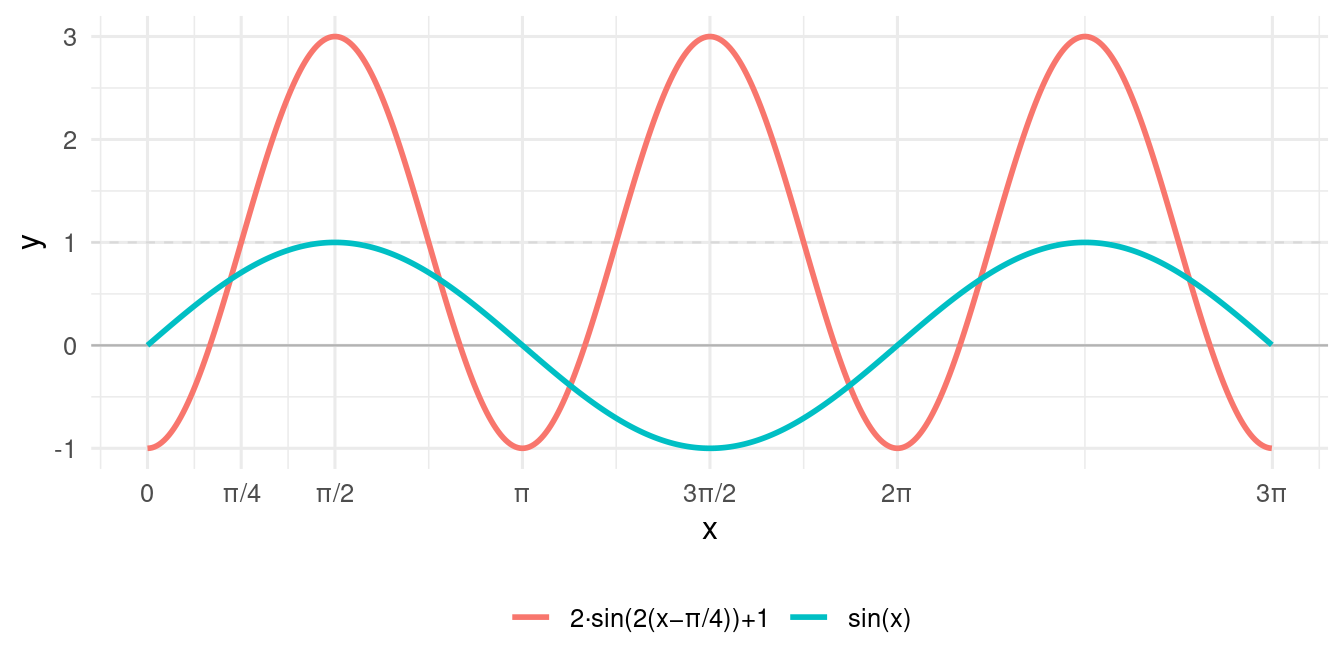
sin(x) und f(x) = 2·sin(2(x − π/4)) + 1 im Vergleich

Aufgaben

Aufgabe 1

L

Bestimme Amplitude und Periode von f(x)=3sin(2x)f(x) = 3 \cdot \sin(2x).

Aufgabe 2

L

Bestimme alle Parameter (|a||a|, TT, cc, dd, Wertebereich) von:

f(x)=sin(x)+2f(x) = -\sin(x) + 2

Aufgabe 3

L

Bestimme alle Parameter von:

f(x)=4cos(3xπ)f(x) = 4 \cdot \cos\!\left(3x - \pi\right)

Hinweis: Forme erst auf die Form acos(b(x+c))+da \cdot \cos(b(x+c)) + d um.

Aufgabe 4

L

Bestimme alle Parameter von:

f(x)=12sin(πx+π3)2f(x) = \frac{1}{2} \cdot \sin\!\left(\pi x + \frac{\pi}{3}\right) - 2

Aufgabe 5

L

Stelle den Funktionsterm auf: Der Graph ist eine Sinusfunktion mit Amplitude 55, Periode 4π4\pi, Mittellage y=3y = 3 und ohne Phasenverschiebung.

Aufgabe 6

L

Bestimme den maximalen und minimalen Wert sowie die Periode von:

f(x)=3cos(2(x+π4))+1f(x) = -3 \cdot \cos\!\left(2\left(x + \frac{\pi}{4}\right)\right) + 1

Bestimme außerdem ein x0x_0, bei dem ff ihr Maximum annimmt.

Aufgabe 7

L

Bestimme Amplitude, Periode und Mittellage von:

f(x)=0,001sin(1000(x+π3))99f(x) = 0{,}001 \cdot \sin\!\left(1000\left(x + \frac{\pi}{3}\right)\right) - 99

Aufgabe 8

L

Bestimme Amplitude, Periode und Mittellage von:

f(x)=200cos(2π365xπ2)+10f(x) = 200 \cdot \cos\!\left(\frac{2\pi}{365}\,x - \frac{\pi}{2}\right) + 10

Gib außerdem an: Bei welchem x>0x > 0 nimmt ff erstmals ihr Maximum an? Welche reale Größe könnte xx bedeuten (Einheit: Tage)?


Lösungen

Lösung 1

a=3a = 3, b=2b = 2:

|a|=3Amplitude=3T=2π2=π|a| = 3 \quad\Rightarrow\quad \text{Amplitude} = 3 \qquad T = \frac{2\pi}{2} = \pi


Lösung 2

f(x)=(1)sin(x)+2f(x) = (-1) \cdot \sin(x) + 2: also a=1a = -1, b=1b = 1, c=0c = 0, d=2d = 2.

  • Amplitude: |a|=1|a| = 1
  • Periode: T=2π1=2πT = \frac{2\pi}{1} = 2\pi
  • Mittellage: y=2y = 2
  • Vorzeichen a<0a < 0: Spiegelung → Maximum wo sin\sin Minimum hat
  • Wertebereich: [21,2+1]=[1,3][2-1, 2+1] = [1, 3]

Lösung 3

Umformen: 3xπ=3(xπ3)3x - \pi = 3\!\left(x - \frac{\pi}{3}\right), also b=3b = 3, c=π3c = -\frac{\pi}{3}, d=0d = 0.

  • Amplitude: |a|=4|a| = 4
  • Periode: T=2π3T = \frac{2\pi}{3}
  • Phasenverschiebung: π3\frac{\pi}{3} nach rechts
  • Mittellage: y=0y = 0, Wertebereich [4,4][-4, 4]

Lösung 4

Umformen: πx+π3=π(x+13)\pi x + \frac{\pi}{3} = \pi\!\left(x + \frac{1}{3}\right), also b=πb = \pi, c=13c = \frac{1}{3}, d=2d = -2.

  • Amplitude: |a|=12|a| = \frac{1}{2}
  • Periode: T=2ππ=2T = \frac{2\pi}{\pi} = 2
  • Phasenverschiebung: 13\frac{1}{3} nach links
  • Mittellage: y=2y = -2, Wertebereich [2,5,1,5]\left[-2{,}5,\; -1{,}5\right]

Lösung 5

Gesucht: a=5a = 5, T=4πT = 4\pi (also b=2π4π=12b = \frac{2\pi}{4\pi} = \frac{1}{2}), d=3d = 3, c=0c = 0.

f(x)=5sin(12x)+3f(x) = 5 \cdot \sin\!\left(\frac{1}{2}\,x\right) + 3


Lösung 6

a=3a = -3, b=2b = 2, c=π4c = \frac{\pi}{4}, d=1d = 1.

  • Periode: T=2π2=πT = \frac{2\pi}{2} = \pi
  • Mittellage: y=1y = 1
  • Wertebereich: [13,1+3]=[2,4][1-3, 1+3] = [-2, 4]

Da a<0a < 0: Maximum dort, wo cos(2(x+π4))=1\cos\!\left(2\!\left(x + \frac{\pi}{4}\right)\right) = -1, also:

2(x+π4)=πx=π42\!\left(x + \frac{\pi}{4}\right) = \pi \quad\Rightarrow\quad x = \frac{\pi}{4}

Maximum: f(π4)=4f\!\left(\frac{\pi}{4}\right) = 4


Lösung 7

a=0,001a = 0{,}001, b=1000b = 1000, d=99d = -99.

  • Amplitude: 0,0010{,}001
  • Periode: T=2π10000,006T = \frac{2\pi}{1000} \approx 0{,}006
  • Mittellage: y=99y = -99

Das Verfahren ist identisch zu Aufgabe 1 — lediglich die Zahlen sind ungewöhnlich.


Lösung 8

a=200a = 200, b=2π365b = \frac{2\pi}{365}, d=10d = 10.

  • Amplitude: 200200
  • Periode: T=2π2π/365=365T = \frac{2\pi}{2\pi/365} = 365 (Tage)
  • Mittellage: y=10y = 10

Maximum bei cos()=1\cos(\ldots) = 1:

2π365xπ2=0x=365491,25 Tage\frac{2\pi}{365}\,x - \frac{\pi}{2} = 0 \quad\Rightarrow\quad x = \frac{365}{4} \approx 91{,}25 \text{ Tage}

Das ist etwa der 21. März — Frühlingsanfang. Die Funktion könnte z.B. die Tageslänge oder Sonneneinstrahlung über das Jahr modellieren.