Modellierung periodischer Vorgänge

Klasse 10

Published

March 15, 2026

Grundidee

Periodische Vorgänge (Gezeiten, Temperaturen, Kreisbewegungen, …) werden durch eine Funktion der Form

W(t)=asin(b(tc))+dW(t) = a \cdot \sin\!\left(b(t - c)\right) + d

modelliert. Vorgehen:

  1. Amplitude: a=MaxMin2\displaystyle a = \frac{\text{Max} - \text{Min}}{2}
  2. Mittellage: d=Max+Min2\displaystyle d = \frac{\text{Max} + \text{Min}}{2}
  3. Periode TT aus dem Kontext ablesen → b=2πT\displaystyle b = \frac{2\pi}{T}
  4. Phasenverschiebung cc aus der Anfangsbedingung bestimmen (wann tritt Mittellage / Maximum / Minimum auf?)

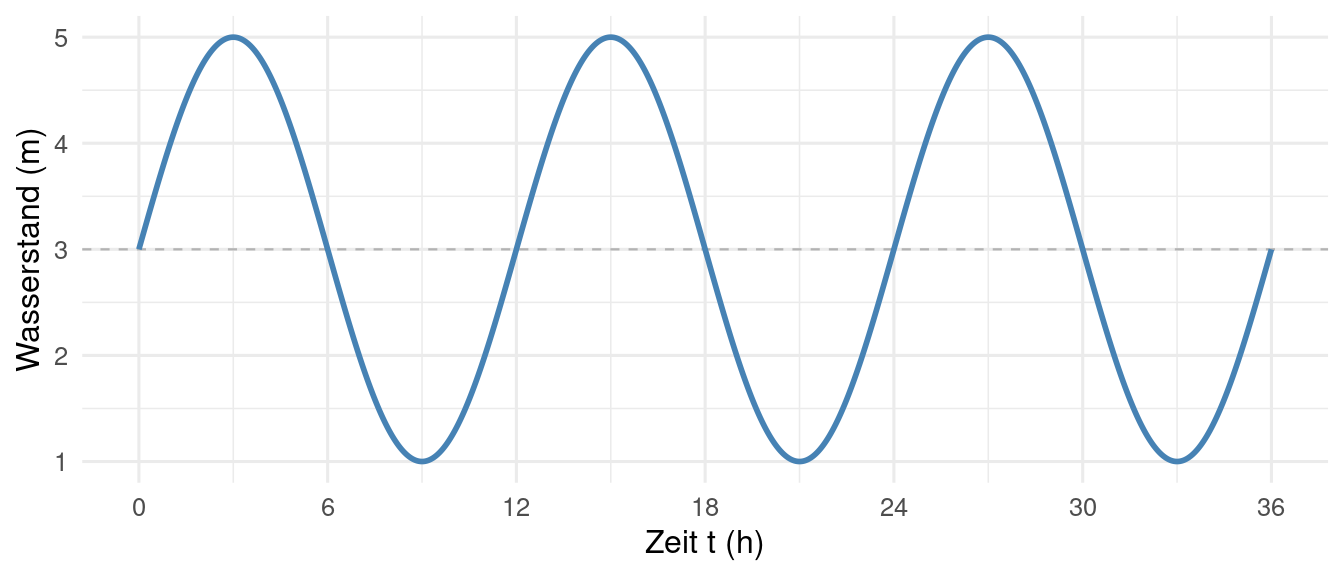
Beispiel: Wasserstand W(t) = 2·sin(π/6 · t) + 3 (Periode 12 h)

Aufgaben

Aufgabe 1

L

Der Wasserstand im Hafen schwankt periodisch: Maximum 5m5\,\text{m}, Minimum 1m1\,\text{m}, Periode 12h12\,\text{h}. Zum Zeitpunkt t=0t = 0 befindet sich der Wasserstand auf der Mittellage und steigt.

Stelle das Modell W(t)W(t) auf und berechne den Wasserstand nach t=9ht = 9\,\text{h}.

Aufgabe 2

L

Die Tagestemperatur lässt sich näherungsweise durch eine Sinusfunktion beschreiben: Minimum 6°C6\,\text{°C} um 3Uhr3\,\text{Uhr}, Maximum 22°C22\,\text{°C}, Periode 24h24\,\text{h}.

  1. Stelle das Modell T(t)T(t) auf (tt in Stunden nach Mitternacht).

  2. Berechne die Temperatur um 15Uhr15\,\text{Uhr}.

Aufgabe 3

L

Ein Punkt auf einem Fahrradrad befindet sich bei t=0t = 0 auf dem höchsten Punkt. Das Rad hat einen Radius von 40cm40\,\text{cm}, die Achse liegt 40cm40\,\text{cm} über dem Boden, und das Rad dreht mit einer Umdrehung pro Sekunde.

  1. Stelle ein Modell h(t)h(t) für die Höhe des Punktes über dem Boden auf.

  2. In welcher Höhe befindet sich der Punkt nach t=0,375st = 0{,}375\,\text{s}?

Aufgabe 4

L

Gezeiten: Das erste Maximum beträgt 6,2m6{,}2\,\text{m} bei t=3ht = 3\,\text{h}, das erste Minimum beträgt 0,4m0{,}4\,\text{m}. Die Periode beträgt 12,5h12{,}5\,\text{h}.

  1. Stelle das Modell H(t)H(t) auf.

  2. Berechne H(9,5)H(9{,}5) auf eine Dezimalstelle genau.

Aufgabe 5

L

Auf einem fremden Planeten schwankt die Temperatur sinusförmig zwischen 180°C-180\,\text{°C} und +220°C+220\,\text{°C}. Ein Planetentag dauert 1000h1000\,\text{h}. Zum Zeitpunkt t=0t = 0 herrscht das Minimum.

  1. Stelle das Modell T(t)T(t) auf.

  2. Berechne die Temperatur nach 250h250\,\text{h}.

  3. Ab welchem Zeitpunkt t>0t > 0 übersteigt die Temperatur erstmals 100°C100\,\text{°C}?

Aufgabe 6

L

Die scheinbare Magnitude (Helligkeit) eines Quasars schwankt sinusförmig zwischen 4,04{,}0 und 16,016{,}0. Die Periode beträgt 3,73{,}7 Jahre. Zum Zeitpunkt t=0t = 0 beträgt die Magnitude 10,010{,}0 und nimmt zu (größere Magnitude = dunkler).

  1. Stelle das Modell M(t)M(t) auf (tt in Jahren).

  2. Nach wie vielen Jahren wird der Quasar erstmals am dunkelsten (Maximum der Magnitude)?


Lösungen

Lösung 1

a=512=2a = \frac{5-1}{2} = 2, d=5+12=3\quad d = \frac{5+1}{2} = 3, T=12b=2π12=π6\quad T = 12 \Rightarrow b = \frac{2\pi}{12} = \frac{\pi}{6}

Bei t=0t=0 Mittellage und steigend → kein Phasenshift (c=0c = 0):

W(t)=2sin(π6t)+3W(t) = 2 \cdot \sin\!\left(\frac{\pi}{6}\,t\right) + 3

Nach 9h9\,\text{h}:

W(9)=2sin(9π6)+3=2sin(3π2)+3=2(1)+3=1mW(9) = 2 \cdot \sin\!\left(\frac{9\pi}{6}\right) + 3 = 2 \cdot \sin\!\left(\frac{3\pi}{2}\right) + 3 = 2 \cdot (-1) + 3 = 1\,\text{m}


Lösung 2

  1. a=2262=8a = \frac{22-6}{2} = 8, d=22+62=14d = \frac{22+6}{2} = 14, T=24b=2π24=π12T = 24 \Rightarrow b = \frac{2\pi}{24} = \frac{\pi}{12}

Minimum bei t=3t = 3, also sin(b(tc))=1\sin(b(t-c)) = -1 bei t=3t=3:

π12(3c)=π23c=6c=9\frac{\pi}{12}(3 - c) = -\frac{\pi}{2} \quad\Rightarrow\quad 3 - c = -6 \quad\Rightarrow\quad c = 9

T(t)=8sin(π12(t9))+14T(t) = 8 \cdot \sin\!\left(\frac{\pi}{12}(t - 9)\right) + 14

  1. T(15)=8sin(π126)+14=8sin(π2)+14=8+14=22°CT(15) = 8 \cdot \sin\!\left(\frac{\pi}{12} \cdot 6\right) + 14 = 8 \cdot \sin\!\left(\frac{\pi}{2}\right) + 14 = 8 + 14 = 22\,\text{°C}

(Das Maximum — plausibel für 15Uhr15\,\text{Uhr}.)


Lösung 3

  1. Achse bei 40cm40\,\text{cm}, Radius 40cm40\,\text{cm}: Max =80cm= 80\,\text{cm}, Min =0cm= 0\,\text{cm}.

a=40a = 40, d=40d = 40, T=1sb=2πT = 1\,\text{s} \Rightarrow b = 2\pi

Bei t=0t=0 auf dem höchsten Punkt → Kosinusfunktion (oder Sinus mit Phasenshift π2-\frac{\pi}{2}):

h(t)=40cos(2πt)+40h(t) = 40 \cdot \cos(2\pi t) + 40

  1. h(0,375)=40cos(0,75π)+40=40cos(135°)+40=40(22)+40h(0{,}375) = 40 \cdot \cos(0{,}75\pi) + 40 = 40 \cdot \cos(135°) + 40 = 40 \cdot \left(-\frac{\sqrt{2}}{2}\right) + 40

=402024028,311,7cm= 40 - 20\sqrt{2} \approx 40 - 28{,}3 \approx 11{,}7\,\text{cm}


Lösung 4

  1. a=6,20,42=2,9a = \frac{6{,}2 - 0{,}4}{2} = 2{,}9, d=6,2+0,42=3,3d = \frac{6{,}2 + 0{,}4}{2} = 3{,}3, T=12,5b=2π12,5=4π25T = 12{,}5 \Rightarrow b = \frac{2\pi}{12{,}5} = \frac{4\pi}{25}

Maximum bei t=3t = 3:

4π25(3c)=π23c=258c=33,125=0,125\frac{4\pi}{25}(3 - c) = \frac{\pi}{2} \quad\Rightarrow\quad 3 - c = \frac{25}{8} \quad\Rightarrow\quad c = 3 - 3{,}125 = -0{,}125

H(t)=2,9sin(4π25(t+0,125))+3,3H(t) = 2{,}9 \cdot \sin\!\left(\frac{4\pi}{25}(t + 0{,}125)\right) + 3{,}3

  1. H(9,5)=2,9sin(4π259,625)+3,3H(9{,}5) = 2{,}9 \cdot \sin\!\left(\frac{4\pi}{25} \cdot 9{,}625\right) + 3{,}3

4π259,625=38,5π254,838rad\frac{4\pi}{25} \cdot 9{,}625 = \frac{38{,}5\pi}{25} \approx 4{,}838\,\text{rad}

sin(4,838)1,00\sin(4{,}838) \approx -1{,}00 (nahe 3π2\frac{3\pi}{2})

H(9,5)2,9(1)+3,3=0,4mH(9{,}5) \approx 2{,}9 \cdot (-1) + 3{,}3 = 0{,}4\,\text{m} (Minimum, plausibel: halbe Periode nach dem Maximum)


Lösung 5

  1. a=220(180)2=200a = \frac{220 - (-180)}{2} = 200, d=220+(180)2=20d = \frac{220 + (-180)}{2} = 20

T=1000b=2π1000=π500T = 1000 \Rightarrow b = \frac{2\pi}{1000} = \frac{\pi}{500}

Minimum bei t=0t=0: sin(b(0c))=1c=T4=250\sin(b(0-c)) = -1 \Rightarrow c = \frac{T}{4} = 250 — oder einfacher: Kosinusfunktion negieren:

T(t)=200cos(π500t)+20T(t) = -200 \cdot \cos\!\left(\frac{\pi}{500}\,t\right) + 20

  1. T(250)=200cos(250π500)+20=200cos(π2)+20=0+20=20°CT(250) = -200 \cdot \cos\!\left(\frac{250\pi}{500}\right) + 20 = -200 \cdot \cos\!\left(\frac{\pi}{2}\right) + 20 = 0 + 20 = 20\,\text{°C}

(Mittellage nach einem Viertel der Periode — plausibel.)

  1. T(t)>100T(t) > 100:

200cos(π500t)+20=100cos(π500t)=0,4-200\cos\!\left(\frac{\pi}{500}t\right) + 20 = 100 \quad\Rightarrow\quad \cos\!\left(\frac{\pi}{500}t\right) = -0{,}4

π500t=arccos(0,4)1,982t5001,982π315h\frac{\pi}{500}t = \arccos(-0{,}4) \approx 1{,}982 \quad\Rightarrow\quad t \approx \frac{500 \cdot 1{,}982}{\pi} \approx 315\,\text{h}


Lösung 6

  1. a=1642=6a = \frac{16 - 4}{2} = 6, d=16+42=10d = \frac{16+4}{2} = 10, T=3,7b=2π3,7T = 3{,}7 \Rightarrow b = \frac{2\pi}{3{,}7}

Bei t=0t=0: Mittellage mit zunehmender Tendenz → Standardsinus, kein Phasenshift:

M(t)=6sin(2π3,7t)+10M(t) = 6 \cdot \sin\!\left(\frac{2\pi}{3{,}7}\,t\right) + 10

  1. Maximum (Magnitude 16, also dunkelster Punkt) bei sin()=1\sin(\ldots) = 1:

2π3,7t=π2t=3,74=0,925Jahre\frac{2\pi}{3{,}7}\,t = \frac{\pi}{2} \quad\Rightarrow\quad t = \frac{3{,}7}{4} = 0{,}925\,\text{Jahre}