Bogenmaß und Einheitskreis

Klasse 10

Published

March 15, 2026

Grundidee

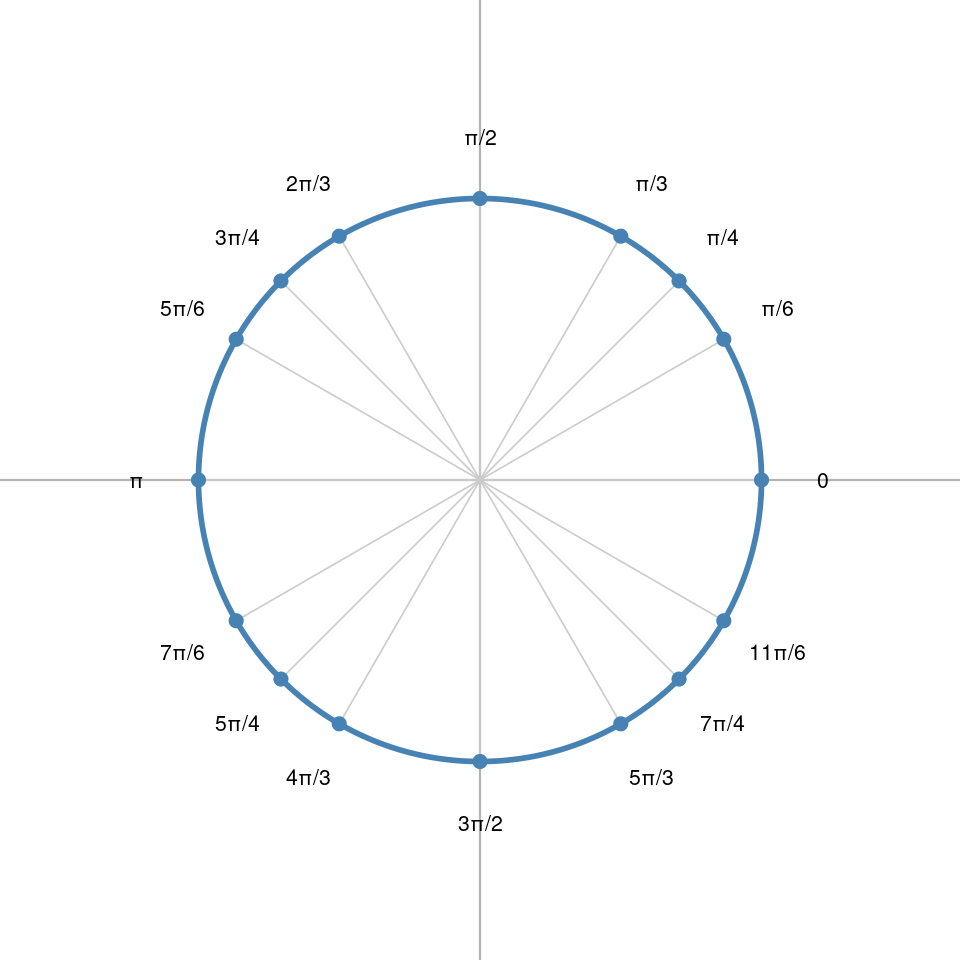
Das Bogenmaß (Radiant) gibt einen Winkel als Länge des Kreisbogens auf dem Einheitskreis (Radius 1) an.

Umrechnung:

αrad=π180α°α°=180παrad\alpha_{\text{rad}} = \frac{\pi}{180} \cdot \alpha_{°} \qquad \alpha_{°} = \frac{180}{\pi} \cdot \alpha_{\text{rad}}

Wichtige Werte:

Grad 30° 45° 60° 90° 120° 180° 270° 360°
Bogenmaß 00 π6\frac{\pi}{6} π4\frac{\pi}{4} π3\frac{\pi}{3} π2\frac{\pi}{2} 2π3\frac{2\pi}{3} π\pi 3π2\frac{3\pi}{2} 2π2\pi

Einheitskreis: Der Punkt zum Winkel α\alpha hat die Koordinaten P(α)=(cosα,sinα)P(\alpha) = (\cos\alpha,\; \sin\alpha).

Einheitskreis mit wichtigen Winkeln

Aufgaben

Aufgabe 1

L

Rechne ins Bogenmaß um: 90°90°

Aufgabe 2

L

Rechne ins Bogenmaß um: 30°,150°,315°\quad 30°, \quad 150°, \quad 315°

Aufgabe 3

L

Rechne ins Gradmaß um: 2π3,7π6,5π4\quad \dfrac{2\pi}{3}, \quad \dfrac{7\pi}{6}, \quad \dfrac{5\pi}{4}

Aufgabe 4

L

Bestimme die exakten Werte ohne Taschenrechner:

sin(3π2),cos(2π3),sin(5π6)\sin\!\left(\frac{3\pi}{2}\right), \qquad \cos\!\left(\frac{2\pi}{3}\right), \qquad \sin\!\left(\frac{5\pi}{6}\right)

Aufgabe 5

L

Bestimme alle α[0,2π]\alpha \in [0, 2\pi] mit cos(α)=12\cos(\alpha) = -\dfrac{1}{2}.

Aufgabe 6

L

Berechne ohne Taschenrechner und vereinfache:

sin2(π3)+cos2(π3)\sin^2\!\left(\frac{\pi}{3}\right) + \cos^2\!\left(\frac{\pi}{3}\right)

Nutze dann dieselbe Überlegung: Was ergibt sin2(α)+cos2(α)\sin^2(\alpha) + \cos^2(\alpha) für beliebiges α\alpha?

Aufgabe 7

L

Rechne 7200°7200° ins Bogenmaß um. Welchen Wert hat sin(7200°)\sin(7200°)?

Aufgabe 8

L

Gib die Koordinaten des Punktes P(α)P(\alpha) auf dem Einheitskreis für α=2025π\alpha = 2025\pi an. Begründe kurz.


Lösungen

Lösung 1

90°π180=π290° \cdot \frac{\pi}{180} = \frac{\pi}{2}


Lösung 2

30°π6150°5π6315°7π430° \to \frac{\pi}{6} \qquad 150° \to \frac{5\pi}{6} \qquad 315° \to \frac{7\pi}{4}


Lösung 3

2π3180π=120°7π6180π=210°5π4180π=225°\frac{2\pi}{3} \cdot \frac{180}{\pi} = 120° \qquad \frac{7\pi}{6} \cdot \frac{180}{\pi} = 210° \qquad \frac{5\pi}{4} \cdot \frac{180}{\pi} = 225°


Lösung 4

3π2\frac{3\pi}{2} entspricht 270°270°, dort ist der Punkt (0,1)(0, -1): sin(3π2)=1\sin\!\left(\tfrac{3\pi}{2}\right) = -1

2π3\frac{2\pi}{3} entspricht 120°120°, Punkt (12,32)\left(-\frac{1}{2}, \frac{\sqrt{3}}{2}\right): cos(2π3)=12\cos\!\left(\tfrac{2\pi}{3}\right) = -\frac{1}{2}

5π6\frac{5\pi}{6} entspricht 150°150°, Punkt (32,12)\left(-\frac{\sqrt{3}}{2}, \frac{1}{2}\right): sin(5π6)=12\sin\!\left(\tfrac{5\pi}{6}\right) = \frac{1}{2}


Lösung 5

cos(α)=12\cos(\alpha) = -\frac{1}{2} liegt im 2. und 3. Quadranten (dort ist cos<0\cos < 0).

Grundwinkel: cos(π3)=12\cos\!\left(\frac{\pi}{3}\right) = \frac{1}{2}, also:

α1=ππ3=2π3,α2=π+π3=4π3\alpha_1 = \pi - \frac{\pi}{3} = \frac{2\pi}{3}, \qquad \alpha_2 = \pi + \frac{\pi}{3} = \frac{4\pi}{3}


Lösung 6

sin2(π3)+cos2(π3)=(32)2+(12)2=34+14=1\sin^2\!\left(\frac{\pi}{3}\right) + \cos^2\!\left(\frac{\pi}{3}\right) = \left(\frac{\sqrt{3}}{2}\right)^2 + \left(\frac{1}{2}\right)^2 = \frac{3}{4} + \frac{1}{4} = 1

Allgemein gilt der trigonometrische Pythagoras: sin2(α)+cos2(α)=1\sin^2(\alpha) + \cos^2(\alpha) = 1 für alle α\alpha \in \mathbb{R}.


Lösung 7

7200°π180=40π7200° \cdot \frac{\pi}{180} = 40\pi

Da 40π=202π40\pi = 20 \cdot 2\pi, liegt 7200°7200° nach genau 20 vollen Umdrehungen wieder bei 0°:

sin(7200°)=sin(40π)=sin(0)=0\sin(7200°) = \sin(40\pi) = \sin(0) = 0


Lösung 8

2025π=2024π+π=10122π+π2025\pi = 2024\pi + \pi = 1012 \cdot 2\pi + \pi

Nach 10121012 vollen Umdrehungen bleibt π\pi übrig — das entspricht 180°180°, also dem Punkt (1,0)(-1, 0).

P(2025π)=(1,0)cos(2025π)=1,sin(2025π)=0P(2025\pi) = (-1,\; 0) \qquad \Rightarrow \qquad \cos(2025\pi) = -1,\quad \sin(2025\pi) = 0