(Vogel-) Käfig
The Awakening Conscience
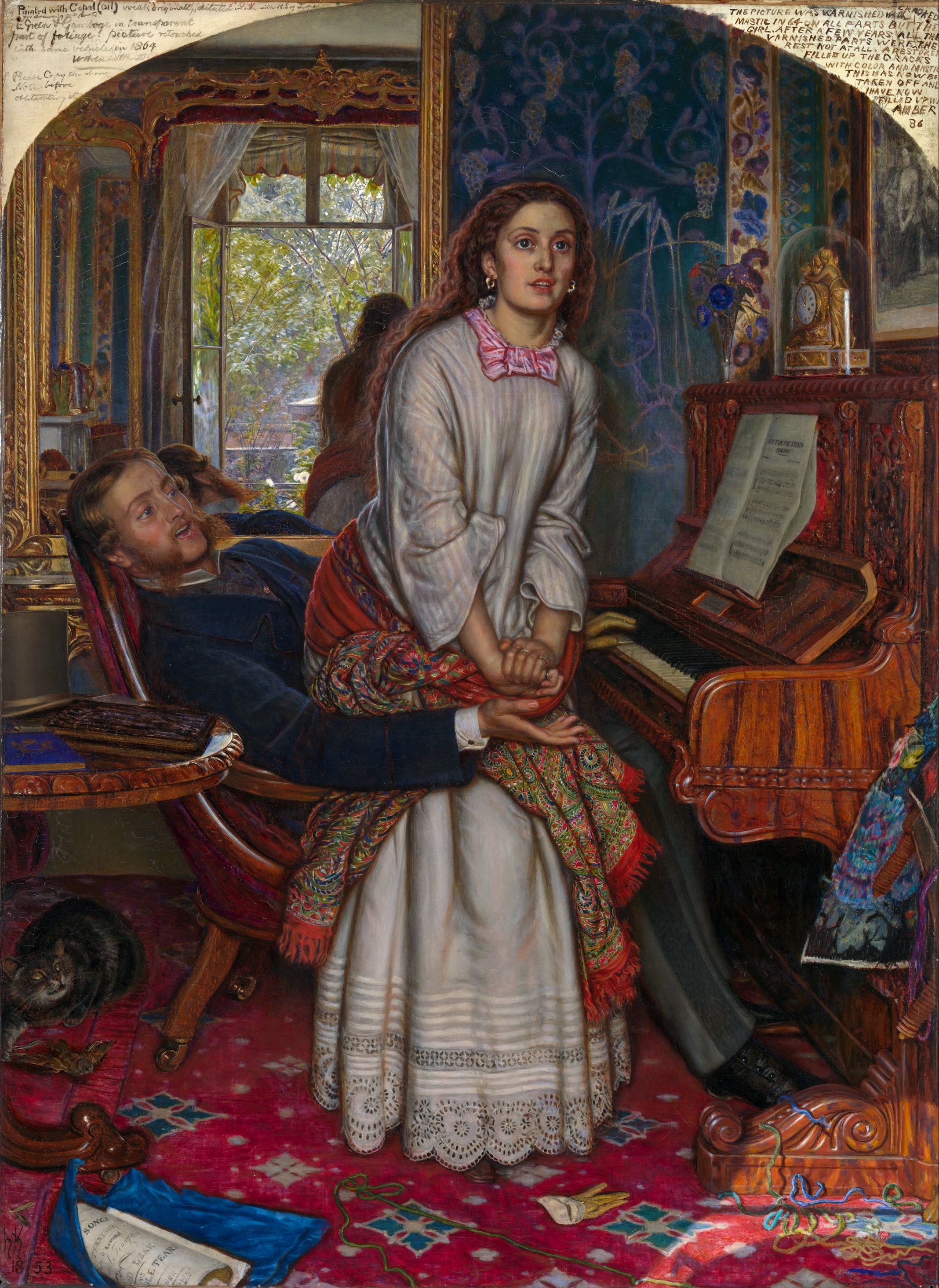
As he that taketh away a garment in cold weather, so is he that singeth songs to an heavy heart.
Erst Bild in Ruhe anschauen, dann: Im Aufstehen begriffen - Das Fenster ist offen, die Uhr unter der Glashaube, die Katze spielt mit dem Vogel, der nicht fliegt. Drei Ringe, aber Ringfinger leer. Rotes Tuch um Hüfte…
Auf dem Notenpult liegt sicher - ähm - Tristan und Isolde?. Nein, Es ist Oft in the Stilly Night von Thomas Moore.
Wir können es anhören: Oft in the Stilly Night- Thomas Moore
Smarthistory: Hunt, The Awakening Conscience
Vermutlich hängt ein Druck dieses Bildes über dem Klavier. (Vgl. Puccini, La Bohème) Frank Stone, Cross purposes (Missverständnisse oder so) Siehe auch: Mozarts Così fan tutte zu diesem Bild.
William Holman Hunt
Der folgende Abschnitt ist eine gekürzte Übernahme aus dem Wikipedia-Artikel William Holman Hunt und steht unter CC BY-SA 4.0.1
Die meisten der hier im Artikel erwähnten Personen gehören dem Dunstkreis der Gruppe der Präraffaeliten (PRB) an. Viele der Lebensgeschichten sind spannend! Siehe auch John Ruskin in den Fußnoten.
Leben und Werk
William Holman Hunt war der Sohn eines Warenhausbetreibers und begann zunächst eine Ausbildung als kaufmännischer Angestellter. Er nahm Zeichenstunden und fertigte Musterentwürfe an. Zwischen 1834 und 1844 betätigte er sich als Kopist im British Museum und in der National Gallery. 1843 bewarb er sich bei den Royal Academy Schools in London und wurde bei seinem dritten Anlauf im Jahr 1845 zugelassen. 1848 war Hunt einer der Mitbegründer der präraffaelitischen Bruderschaft. Er bewunderte John Ruskins mehrbändiges Werk Modern Painters von 1843 und die Gedichte von John Keats. Mit John Everett Millais schloss er Freundschaft.
Im selben Jahr 1848 stellte er in der Royal Academy sein Werk St. Agnesabend aus, das von Ruskin bewundert wurde und als erstes präraffaelitisches Gemälde gilt. Als gläubiger Anglikaner unterstrich Hunt den moralischen Ernst dieser Bewegung. Das Werk Eine bekehrte Britenfamilie verbirgt einen Missionar vor der Verfolgung durch die Druiden erfuhr 1850 wegen seiner kompromisslosen Naturtreue scharfe Kritik. Ein weiteres Gemälde mit dem Titel Zwei Herren aus Verona fand 1851 ebenfalls keine günstige Aufnahme beim Publikum. Hunt dachte daran auszuwandern. Ruskins Lob dreier Werke in den folgenden Jahren, Der Mietling (1852), Das Licht der Welt (1851/56) und Erwachendes Gewissen (1853), ließen ihn von derartigen Plänen wieder Abstand nehmen.
Im Januar 1854 trat er eine Reise ins Heilige Land an; 1856 kehrte er nach London zurück. Mit dem Gemälde Die Auffindung Jesu im Tempel, das er 1860 verkaufte, sicherte Hunt seine Finanzen und seinen Ruf als Künstler. 1865 heiratete er Fanny Waugh, die ein knappes Jahr später in Florenz bei der Geburt des Sohnes Cyril starb. Hunt heiratete 1875 ein weiteres Mal, und zwar Fannys Schwester Edith. Zwischen 1869 und 1878 unternahm er noch mehrere Reisen nach Griechenland, Italien und Ägypten und wiederum nach Palästina, das er im Jahr 1892 zum vierten Mal besuchte.
Ab 1874 stellte er nicht mehr in der Royal Academy of Arts aus, sondern in der Grosvenor Gallery und New Galleries. 1882 zog er nach Fulham, wo er insgesamt 32 Gemälde fertigstellte, die 1886 in der Fine Art Society gezeigt wurden. Zwischen 1886 und 1905 entstand das Gemälde Die Dame von Shalott, das von der bekannten Ballade gleichen Titels von Alfred Tennyson inspiriert war.
Hunt schrieb eine Autobiografie mit dem Titel Pre-Raphaelitism and the Pre-Raphaelite Brotherhood, die 1905 erschien. In den Jahren 1906 und 1907 fanden in London, Manchester, Liverpool und Glasgow Retrospektivausstellungen seiner Werke statt. Hunt starb 1910 und wurde in der St Paul’s Cathedral in London beigesetzt.
Found
Gegeben auch dieses Bild, das nicht nur durch Epoche, Symbolik und Stil mit dem obigen verwandt ist, sondern auch durch persönliche Bekanntschaft der beiden Urheber. Dante Gabriel Rossetti, halb Dichter, halb Maler, war mit Holman Hunt befreundet und schickte ihm bezüglich dieses Bildes einen Brief.
_Google_Art_Project.jpeg)
I can tell you, on my own side, of only one picture fairly begun—indeed, I may say, all things considered, rather advanced; but it is only a small one. The subject had been sometime designed before you left England and will be thought, by any one who sees it when (and if) finished, to follow in the wake of your “Awakened Conscience,” but not by yourself, as you know I had long had in view subjects taking the same direction as my present one. The picture represents a London street at dawn, with the lamps still lighted along a bridge which forms the distant background. A drover has left his cart standing in the middle of the road (in which, i. e. the cart, stands baa-ing a calf tied on its way to market), and has run a little way after a girl who has passed him, wandering in the streets. He has just come up with her and she, recognising him, has sunk under her shame upon her knees, against the wall of a raised churchyard in the foreground, while he stands holding her hands as he seized them, half in bewilderment and half guarding her from doing herself a hurt. These are the chief things in the picture which is to be called “Found,” and for which my sister Maria has found me a most lovely motto from Jeremiah … The calf, a white one, will be a beautiful and suggestive part of the thing, though I am far from having painted him as well as I hoped to do.
— Dante Gabriel Rossetti, Brief an Holman Hunt, 1853
Dante Gabriel Rossetti
Etwas mehr zu Rossetti, da sehr interessant:
Der folgende Abschnitt ist eine gekürzte Übernahme aus dem Wikipedia-Artikel Dante Gabriel Rossetti und steht unter CC BY-SA 4.0.2
Leben
Dante Gabriel Rossetti wuchs als zweites von vier begabten Kindern auf. Seine Geschwister waren Maria Francesca Rossetti, William Michael Rossetti und Christina Georgina Rossetti. Die Familie lebte in der Charlotte Street nahe des Regent’s Park.
Sein Vater Gabriele Rossetti war aus Italien geflohen und arbeitete als Dichter und Wissenschaftler. Seine Mutter, Frances Mary Lavinia Polidori, war Tochter von Gaetano Polidori und Schwester von John Polidori, ebenfalls Lehrerin.
Da sein Vater Professor am King’s College London war, erhielt Rossetti eine gute Schulbildung sowie Zeichenunterricht. 1842 schrieb er sich an der Cary’s Academy ein. 1846 wurde er Schüler an der Antique School der Royal Academy, verließ diese aber wieder, da ihm der Unterricht nicht gefiel.
Im März 1848 bat er Ford Madox Brown, sein Lehrer zu werden. Brown versuchte ihn nach alten akademischen Lehrmethoden zu unterrichten, was Rossetti enttäuschte. Er verließ Brown als Schüler, blieb ihm aber als Freund verbunden.
Bis zu seinem 20. Geburtstag war Rossetti unentschlossen zwischen Dichter und Maler. Er schickte Gedichte an den Poeten Leigh Hunt, der ihn lobte, aber betonte, dass es schwieriger sei, mit der Literatur als mit der Malerei Geld zu verdienen.
Entscheidend waren seine Freundschaften zu William Holman Hunt und John Everett Millais. Alle drei waren über den Zustand der britischen Kunst bestürzt und lehnten die herrschenden Konventionen ab. Sie nannten sich die Präraffaeliten.
1848 gründeten sie mit weiteren Freunden, darunter Rossettis Bruder William, die Präraffaelitische Bruderschaft, kurz PRB. Diese Initialen standen auf Rossettis erstem Ölgemälde, der Jugendzeit der Jungfrau Maria, das viel Lob erhielt.
Als die Presse „PRB” entzifferte, wurden Rossetti und seine Freunde scharf angegriffen. Er verfiel in eine Depression. Ab 1852 löste sich die PRB auf. Von 1850 bis 1860 gab Rossetti die Ölmalerei fast völlig auf und widmete sich kleinformatigen Aquarellen. Dank des Kritikers John Ruskin, den er 1854 kennenlernte, verkauften sich diese gut.
Bereits 1849 oder 1850 begegnete er Elizabeth Eleanor Siddal, die er später heiratete. „Lizzie” entsprach dem Frauenideal der Präraffaeliten und war Rossetti ein Leben lang Muse und Quelle der Inspiration.
Ab 1858 spielte auch Fanny Cornforth eine Rolle — das Gegenteil der zarten, kränkelnden Lizzie.
1858 freundete er sich mit zwei Oxfordstudenten an und malte mit ihnen den Sitzungssaal der Oxford University Union mit Szenen der Artussage.
Ein Jahr nach der Hochzeit 1860 brachte Lizzie ein totes Kind zur Welt und erlitt einen Nervenzusammenbruch. 1862 nahm sie sich mit einer Überdosis Laudanum das Leben. Aus Trauer ließ Rossetti sein einziges Gedichtmanuskript mit ihr begraben.
Im selben Jahr pachtete Rossetti das große Haus 16 Cheyne Walk in Chelsea an. Er teilte es sich mit Algernon Charles Swinburne, seinem Bruder William und George Meredith.
Rossetti erneuerte seine Beziehung zu Fanny Cornforth, die für ihn Modell saß, seine Geliebte war und sich um seinen Haushalt kümmerte. Da sich seine Bilder hervorragend verkauften, konnte er noch ein weiteres Modell beschäftigen: Alexa Wilding.
Auch Jane Morris, die Frau seines engen Freundes William Morris, saß ihm Modell. Die jahrelange Affäre der beiden trug sich unter den Augen William Morris’ zu, der nicht einschreiten wollte.
Rossetti sammelte exotische Tiere in seinem Garten: Wallabys, Kängurus, einen Waschbären, ein Zebu und einen Tukan. Er liebte besonders Wombats.
Gegen Schlaflosigkeit nahm Rossetti Chloralhydrat, dessen Nebenwirkungen damals unbekannt waren. 1871 schluckte er eine Phiole Laudanum und schwebte einige Tage zwischen Leben und Tod.
Von September 1872 bis 1874 wohnte und arbeitete er in Kelmscott Manor. Als Jane Morris 1876 das Ausmaß seiner Chloral-Sucht entdeckte, brach sie die Beziehung zu ihm ab. Alkohol und Drogen verursachten Wahnvorstellungen und ließen seine Hände zittern.
1881 erlitt er einen Schlaganfall mit Lähmungen des linken Arms und Beins. Im Februar 1882 machte er Urlaub in Birchington-on-Sea. Dort starb er an Nierenversagen am Ostersonntag, dem 9. April 1882.
Seine Musen
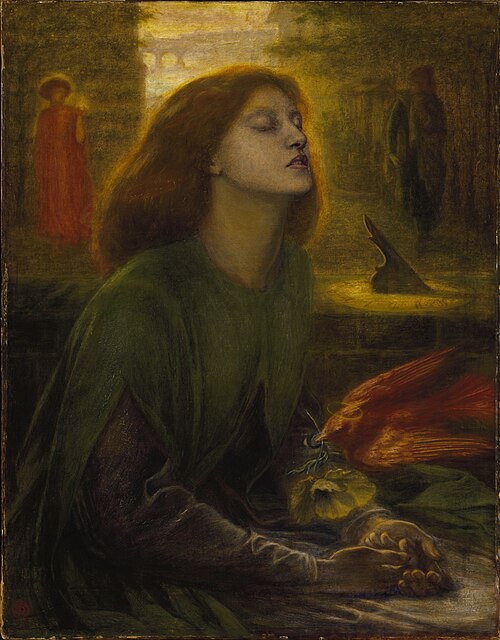
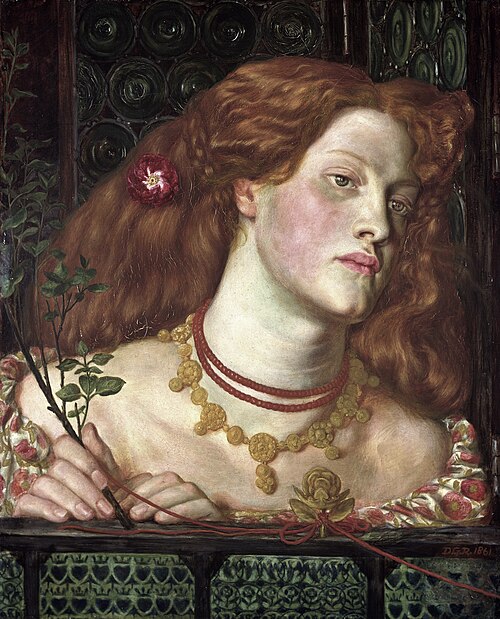
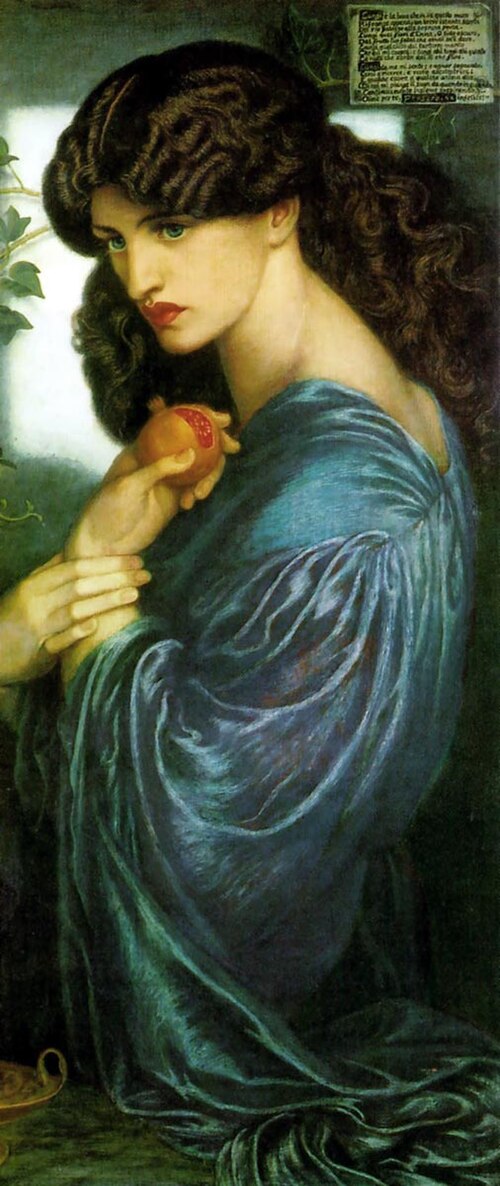
Jenny
Jenny ist ein Gedicht von Rossetti, das Hunt mit Sicherheit kannte. Leider lang, doch mit schönem Bezug zu Awakening Conscience…
Jenny
Lazy laughing languid Jenny,
Fond of a kiss and fond of a guinea,
Whose head upon my knee to-night
Rests for a while, as if grown light
With all our dances and the sound
To which the wild tunes spun you round:
Fair Jenny mine, the thoughtless queen
Of kisses which the blush between
Could hardly make much daintier;
Whose eyes are as blue skies, whose hair
Is countless gold incomparable:
Fresh flower, scarce touched with signs that tell
Of Love’s exuberant hotbed:—Nay,
Poor flower left torn since yesterday
Until to-morrow leave you bare;
Poor handful of bright spring-water
Flung in the whirlpool’s shrieking face;
Poor shameful Jenny, full of grace
Thus with your head upon my knee;—
Whose person or whose purse may be
The lodestar of your reverie?
This room of yours, my Jenny, looks
A change from mine so full of books,
Whose serried ranks hold fast, forsooth,
So many captive hours of youth,—
The hours they thieve from day and night
To make one’s cherished work come right,
And leave it wrong for all their theft,
Even as to-night my work has left:
Until I vowed that since my brain
And eyes of dancing seemed so fain,
My feet should have some dancing too:—
And thus it was I met with you.
Well, I suppose ’twas hard to part,
For here I am. And now, sweetheart,
You seem too tired to get to bed.
It was a careless life I led
When rooms like this were scarce so strange
Not long ago. What breeds the change,—
The many aims or the few years?
Because to-night it all appears
Something I do not know again.
The cloud’s not danced out of my brain,—
The cloud that made it turn and swim
While hour by hour the books grew dim.
Why, Jenny, as I watch you there,—
For all your wealth of loosened hair,
Your silk ungirdled and unlac’d
And warm sweets open to the waist,
All golden in the lamplight’s gleam,—
You know not what a book you seem,
Half-read by lightning in a dream!
How should you know, my Jenny? Nay,
And I should be ashamed to say:—
Poor beauty, so well worth a kiss!
But while my thought runs on like this
With wasteful whims more than enough,
I wonder what you’re thinking of.
If of myself you think at all,
What is the thought?—conjectural
On sorry matters best unsolved?—
Or inly is each grace revolved
To fit me with a lure?—or (sad
To think!) perhaps you’re merely glad
That I’m not drunk or ruffianly
And let you rest upon my knee.
For sometimes, were the truth confess’d,
You’re thankful for a little rest,—
Glad from the crush to rest within,
From the heart-sickness and the din
Where envy’s voice at virtue’s pitch
Mocks you because your gown is rich;
And from the pale girl’s dumb rebuke,
Whose ill-clad grace and toil-worn look
Proclaim the strength that keeps her weak,
And other nights than yours bespeak;
And from the wise unchildish elf,
To schoolmate lesser than himself
Pointing you out, what thing you are:—
Yes, from the daily jeer and jar,
From shame and shame’s outbraving too,
Is rest not sometimes sweet to you?—
But most from the hatefulness of man
Who spares not to end what he began,
Whose acts are ill and his speech ill,
Who, having used you at his will,
Thrusts you aside, as when I dine
I serve the dishes and the wine.
Well, handsome Jenny mine, sit up:
I’ve filled our glasses, let us sup,
And do not let me think of you,
Lest shame of yours suffice for two.
What, still so tired? Well, well then, keep
Your head there, so you do not sleep;
But that the weariness may pass
And leave you merry, take this glass.
Ah! lazy lily hand, more bless’d
If ne’er in rings it had been dress’d
Nor ever by a glove conceal’d!
Behold the lilies of the field,
They toil not neither do they spin;
(So doth the ancient text begin,—
Not of such rest as one of these
Can share.) Another rest and ease.
Along each summer-sated path
From its new lord the garden hath,
Than that whose spring in blessings ran
Which praised the bounteous husbandman,
Ere yet, in days of hankering breath,
The lilies sickened unto death.
What, Jenny, are your lilies dead?
Aye, and the snow-white leaves are spread
Like winter on the garden-bed.
But you had roses left in May,—
They were not gone too. Jenny, nay,
But must your roses die, and those
Their purfled buds that should unclose?
Even so; the leaves are curled apart,
Still red as from the broken heart,
And here’s the naked stem of thorns.
Nay, nay mere words. Here nothing warns
As yet of winter. Sickness here
Or want alone could waken fear,—
Nothing but passion wrings a tear.
Except when there may rise unsought
Haply at times a passing thought
Of the old days which seem to be
Much older than any history
That is written in any book;
When she would lie in fields and look
Along the ground through the blown grass,
And wonder where the city was,
Far out of sight, whose broil and bale
They told her then for a child’s tale.
Jenny, you know the city now,
A child can tell the tale there, how
Some things which are not yet enroll’d
In market-lists are bought and sold
Even till the early Sunday light,
When Saturday night is market-night
Everywhere, be it dry or wet,
And market-night in the Haymarket.
Our learned London children know,
Poor Jenny, all your pride and woe;
Have seen your lifted silken skirt
Advertise dainties through the dirt;
Have seen your coach-wheels splash rebuke
On virtue; and have learned your look
When, wealth and health slipped past, you stare
Along the streets alone, and there,
Round the long park, across the bridge,
The cold lamps at the pavement’s edge
Wind on together and apart,
A fiery serpent for your heart.
Let the thoughts pass, an empty cloud!
Suppose I were to think aloud,—
What if to her all this were said?
Why, as a volume seldom read
Being opened halfway shuts again,
So might the pages of her brain
Be parted at such words, and thence
Close back upon the dusty sense.
For is there hue or shape defin’d
In Jenny’s desecrated mind,
Where all contagious currents meet,
A Lethe of the middle street?
Nay, it reflects not any face,
Nor sound is in its sluggish pace,
But as they coil those eddies clot,
And night and day remembers not.
Why, Jenny, you’re asleep at last!—
Asleep, poor Jenny, hard and fast,—
So young and soft and tired; so fair,
With chin thus nestled in your hair,
Mouth quiet, eyelids almost blue
As if some sky of dreams shone through!
Just as another woman sleeps!
Enough to throw one’s thoughts in heaps
Of doubt and horror,—what to say
Or think,—this awful secret sway,
The potter’s power over the clay!
Of the same lump (it has been said)
For honour and dishonour made,
Two sister vessels. Here is one.
My cousin Nell is fond of fun,
And fond of dress, and change, and praise,
So mere a woman in her ways:
And if her sweet eyes rich in youth
Are like her lips that tell the truth,
My cousin Nell is fond of love.
And she’s the girl I’m proudest of.
Who does not prize her, guard her well?
The love of change, in cousin Nell,
Shall find the best and hold it dear:
The unconquered mirth turn quieter
Not through her own, through others’ woe:
The conscious pride of beauty glow
Beside another’s pride in her,
One little part of all they share.
For Love himself shall ripen these
In a kind of soil to just increase
Through years of fertilizing peace.
Of the same lump (as it is said)
For honour and dishonour made,
Two sister vessels. Here is one.
It makes a goblin of the sun.
So pure,—so fall’n! How dare to think
Of the first common kindred link?
Yet, Jenny, till the world shall burn
It seems that all things take their turn;
And who shall say but this fair tree
May need, in changes that may be,
Your children’s children’s charity?
Scorned then, no doubt, as you are scorn’d!
Shall no man hold his pride forewarn’d
Till in the end, the Day of Days,
At Judgement, one of his own race,
As frail and lost as you, shall rise,—
His daughter, with his mother’s eyes?
How Jenny’s clock ticks on the shelf!
Might not the dial scorn itself
That has such hours to register?
Yet as to me, even so to her
Are golden sun and silver moon,
In daily largesse of earth’s boon,
Counted for life-coins to one tune.
And if, as blindfold fates are toss’d,
Through some one man this life be lost,
Shall soul not somehow pray for soul?
Fair shines the gilded aureole
In which our highest painters place
Some living woman’s simple face.
And the stilled features thus descried
As Jenny’s long throat droops aside,—
The shadows where the cheeks are thin,
And pure wide curve from ear to chin,—
With Raffael’s, Leonardo’s hand
To show them to men’s souls, might stand,
Whole ages long, the whole world through,
For preachings of what God can do.
What has man done here? How atone,
Great God, for this which man has done?
And for the body and soul which by
Man’s pitiless doom must now comply
With lifelong hell, what lullaby
Of sweet forgetful second birth
Remains? All dark. No sign on earth
What measure of God’s rest endows
The many mansions of his house.
If but a woman’s heart might see
Such erring heart unerringly
For once! But that can never be.
Like a rose shut in a book
In which pure women may not look,
For its base pages claim control
To crush the flower within the soul;
Where through each dead rose-leaf that clings,
Pale as transparent psyche-wings,
To the vile text, are traced such things
As might make lady’s cheek indeed
More than a living rose to read;
So nought save foolish foulness may
Watch with hard eyes the sure decay;
And so the life-blood of this rose,
Puddled with shameful knowledge, flows
Through leaves no chaste hand may unclose:
Yet still it keeps such faded show
Of when ’twas gathered long ago,
That the crushed petals’ lovely grain,
The sweetness of the sanguine stain,
Seen of a woman’s eyes, must make
Her pitiful heart, so prone to ache,
Love roses better for its sake:—
Only that this can never be:—
Even so unto her sex is she.
Yet, Jenny, looking long at you,
The woman almost fades from view.
A cipher of man’s changeless sum
Of lust, past, present, and to come,
Is left. A riddle that one shrinks
To challenge from the scornful sphinx.
Like a toad within a stone
Seated while Time crumbles on;
Which sits there since the earth was curs’d
For Man’s transgression at the first;
Which, living through all centuries,
Not once has seen the sun arise;
Whose life, to its cold circle charmed,
The earth’s whole summers have not warmed;
Which always—whitherso the stone
Be flung—sits there, deaf, blind, alone;—
Aye, and shall not be driven out
Till that which shuts him round about
Break at the very Master’s stroke,
And the dust thereof vanish as smoke,
And the seed of Man vanish as dust:—
Even so within this world is Lust.
Come, come, what use in thoughts like this?
Poor little Jenny, good to kiss,—
You’d not believe by what strange roads
Thought travels, when your beauty goads
A man to-night to think of toads!
Jenny, wake up. . . . Why, there’s the dawn!
And there’s an early waggon drawn
To market, and some sheep that jog
Bleating before a barking dog;
And the old streets come peering through
Another night that London knew;
And all as ghostlike as the lamps.
So on the wings of day decamps
My last night’s frolic. Glooms begin
To shiver off as lights creep in
Past the gauze curtains half drawn-to,
And the lamp’s doubled shade grows blue,—
Your lamp, my Jenny, kept alight,
Like a wise virgin’s, all one night!
And in the alcove coolly spread
Glimmers with dawn your empty bed;
And yonder your fair face I see
Reflected lying on my knee,
Where teems with first foreshadowings
Your pier-glass scrawled with diamond rings:
And on your bosom all night worn
Yesterday’s rose now droops forlorn,
But dies not yet this summer morn.
And now without, as if some word
Had called upon them that they heard,
The London sparrows far and nigh
Clamour together suddenly;
And Jenny’s cage-bird grown awake
Here in their song his part must take,
Because here too the day doth break.
And somehow in myself the dawn
Among stirred clouds and veils withdrawn
Strikes greyly on her. Let her sleep.
But will it wake her if I heap
These cushions thus beneath her head
Where my knee was? No,—there’s your bed,
My Jenny, while you dream. And there
I lay among your golden hair
Perhaps the subject of your dreams,
These golden coins.
For still one deems
That Jenny’s flattering sleep confers
New magic on the magic purse,—
Grim web, how clogged with shrivelled flies!
Between the threads fine fumes arise
And shape their pictures in the brain.
There roll no streets in glare and rain,
Nor flagrant man-swine whets his tusk;
But delicately sighs in musk
The homage of the dim boudoir;
Or like a palpitating star
Thrilled into song, the opera-night
Breathes faint in the quick pulse of light;
Or at the carriage-window shine
Rich wares for choice; or, free to dine,
Whirls through its hour of health (divine
For her) the concourse of the Park.
And though in the discounted dark
Her functions there and here are one,
Beneath the lamps and in the sun
There reigns at least the acknowledged belle
Apparelled beyond parallel.
Ah Jenny, yes, we know your dreams.
For even the Paphian Venus seems,
A goddess o’er the realms of love,
When silver-shrined in shadowy grove:
Aye, or let offerings nicely placed
But hide Priapus to the waist,
And whoso looks on him shall see
An eligible deity.
Why, Jenny, waking here alone
May help you to remember one,
Though all the memory’s long outworn
Of many a double-pillowed morn.
I think I see you when you wake,
And rub your eyes for me, and shake
My gold, in rising, from your hair,
A Danaë for a moment there.
Jenny, my love rang true! for still
Love at first sight is vague, until
That tinkling makes him audible.
And must I mock you to the last,
Ashamed of my own shame,—aghast
Because some thoughts not born amiss
Rose at a poor fair face like this?
Well, of such thoughts so much I know:
In my life, as in hers, they show,
By a far gleam which I may near,
A dark path I can strive to clear.
Only one kiss. Good-bye, my dear.
Käfig
Awakening Conscience ist vollgepackt mit Symbolik, fast schon wie ein Wimmelbild. Katze mit Vogel, Klavier, Ringe an der Hand, Uhr unter der Glashaube: Ein Käfig für die Zeit selbst!
John Ruskin, der das Bild in einem Brief an die Times vom 25. Mai 1854 verteidigte,3 hebt die Uhr unter der Glashaube hervor. Sie tickt — aber sie steht außerhalb des Lebens. Man betrachtet sie, berührt sie nicht. Die Glashaube konserviert: die Zeit läuft, aber eingeschlossen, ausgestellt, der Welt entzogen. Dieselbe Logik gilt für die Frau.
Rossetti greift in Jenny sowohl die Uhr als auch den Vogelkäfig auf. Die Uhr:
How Jenny’s clock ticks on the shelf! / Might not the dial scorn itself / That has such hours to register?
Der Käfig-Vogel, am Ende des Gedichts, beim Morgengrauen:
And Jenny’s cage-bird grown awake / Here in their song his part must take, / Because here too the day doth break.
Käfig und Glashaube sind dasselbe Prinzip: Schönheit, die eingeschlossen und ausgestellt wird. Das Freie ist sichtbar — der Garten im Spiegel, der Morgen vor dem Fenster — aber der Durchgang fehlt.
Ich möchte aber widersprechen - denn ich sehe noch etwas anderes:
Im Bild spielt die Katze mit einem Vogel, der nicht fliegt - so sagte ich bereits oben. Wer eine Katze hat, weiß, wie tote Vögel aussehen, mit denen Katzen gespielt haben. Hier im Bild sehen wir etwas anderes. Der Vogel ist (körperlich) unversehrt.
Der Garten ist nur durch den Spiegel zu sehen. Die Gardinen zur Seite geschoben, das Fenster geöffnet.
Die Flügel sind ausgebreitet, das Fenster steht offen. Jenny steht nicht auf - sie fliegt davon!
Only one kiss. Good-bye, my dear.
Mehr!
Die Katze - sie sieht nicht auf den Vogel - sie sieht auf Jenny. Man vergleiche auch ihre rechte Pfote mit des Mannes rechter Hand.
Ich sagte: Der Durchgang fehlt. Das gilt nicht für die Fliegende. Der Käfig hat ein Fenster und es ist offen.
Wenn wir uns jetzt das zweite Bild noch einmal ansehen - Found, erkennen wir den größten Unterschied dieser Bilder. Die Kuh ist gebunden und der Kopf ist erschreckend grün.Thematisch passend (“Further reading”):
Thomas Manns Tristan.
La Traviata, Verdi
Die Wikipedia-Artikel zur Gruppe der Präraffaeliten
Fußnoten
Der Abschnitt „Leben und Werk” ist eine gekürzte und sprachlich bearbeitete Übernahme des Artikels William Holman Hunt. In: Wikipedia, Die freie Enzyklopädie, https://de.wikipedia.org/wiki/William_Holman_Hunt (abgerufen am 1. Mai 2026). Die Autorinnen und Autoren sind der Versionsgeschichte zu entnehmen. Der Text steht unter der Lizenz Creative Commons Namensnennung – Weitergabe unter gleichen Bedingungen 4.0 International (CC BY-SA 4.0) und wird hier unter derselben Lizenz weitergegeben.↩︎
- Der Abschnitt „Leben” ist eine gekürzte und sprachlich bearbeitete Übernahme des Artikels Dante Gabriel Rossetti. In: Wikipedia, Die freie Enzyklopädie, https://de.wikipedia.org/wiki/Dante_Gabriel_Rossetti (abgerufen am 1. Mai 2026). Die Autorinnen und Autoren sind der Versionsgeschichte zu entnehmen. Der Text steht unter der Lizenz Creative Commons Namensnennung – Weitergabe unter gleichen Bedingungen 4.0 International (CC BY-SA 4.0) und wird hier unter derselben Lizenz weitergegeben. ↩︎
John Ruskin, Brief an die Times, 25. Mai 1854. In: The Works of John Ruskin, Bd. 12, hg. v. E. T. Cook u. Alexander Wedderburn. London: George Allen, 1904, S. 333–335. Archive.org↩︎